Executive Summary
The emergence of Cartagena as a primary destination for international private capital represents a structural shift in how cross-border wealth views alternative asset allocation in Latin America. While conventional coastal real estate markets remain vulnerable to macroeconomic volatility and uncontrolled developer inventory, Cartagena's historic core operates under rigid physical and legal supply constraints. Bounded by sixteenth-century fortifications and governed by strict preservation regulations, the city's property stock represents an unrepeatable asset class. This publication analyzes the economic, legal, and architectural mechanisms driving the market for Luxury Real Estate Cartagena, examining how spatial scarcity, adaptive reuse physics, and off-market capital flows transform heritage real estate into an inflation-hedged, capital-preserving asset shelter.
The Anomaly of Inelastic Urban Fabric
In standard urban real estate economics, price appreciation triggers a predictable supply-side response. When capital demand intensifies within a metropolitan area, developers expand inventory through vertical densification, peripheral land development, or zoning adjustments that elevate floor-area ratios. This elasticity ensures that, over multi-year cycles, supply eventually expands to meet demand, dampening long-term real appreciation and exposing investors to oversupply risks during economic contractions.
The market for Luxury Real Estate Cartagena operates under a fundamentally opposing dynamic defined by absolute supply inelasticity. The spatial limits of the Cartagena Historic District were not established by modern municipal master planning, but by sixteenth- and seventeenth-century Spanish military engineering. Following repeated maritime sieges, the Spanish Crown executed one of the most extensive defensive projects in the Western Hemisphere: an eleven-kilometer perimeter of coralline limestone walls, bastions, and fortresses designed by military engineers such as Bautista Antonelli.
This defensive enclosure physically capped the footprint of the historic urban core, comprising the contemporary quarters of El Centro, San Diego, and Getsemani. Within this fortified perimeter, horizontal expansion is geographically impossible, bounded by the Caribbean Sea, the Bay of Cartagena, and ancient inland waterways. Furthermore, vertical expansion is strictly prohibited by conservation law. Consequently, the residential and commercial parcel count within the walled city is fixed.
Unlike modern coastal resorts where additional residential towers can be constructed on adjacent parcels, every real estate acquisition within the historic walls represents the transfer of a non-reproducible asset. When global capital inflows intensify, price adjustments cannot be absorbed by inventory creation. Instead, increased capital concentration directly recalibrates the underlying value of the existing property stock.
Institutional Perspective Real estate markets anchored solely in leisure amenities are inherently exposed to supply elasticity and changing consumer preferences. Markets anchored in physically capped, legally protected urban history operate under different economic rules. Cartagena matters to global capital because its historical core represents a closed asset system where inventory cannot be inflated by developer leverage or municipal zoning expansion.
Regulatory Institutionalization: From UNESCO Codification to the PEMP Framework
Physical limits alone do not guarantee capital protection; they require formal legal codification to prevent municipal decay or unauthorized structural alterations. The modern institutionalization of Cartagena's heritage market began in 1984, when UNESCO designated the port, fortresses, and historic monument group of Cartagena as a World Heritage Site. This international status integrated the city into global conservation protocols and mandated national legislative safeguards for UNESCO Real Estate assets.
The primary regulatory instrument governing this spatial perimeter is the Plan Especial de Manejo y Protección (PEMP). Formulated under the oversight of Colombia's Ministry of Culture and local planning authorities (Secretaría de Planeación Distrital), the PEMP establishes binding parameters for real estate intervention, land use, and structural conservation across the Historic Center and its zone of influence.
The PEMP framework establishes four critical constraints that directly govern property values across Historic Properties Cartagena:
- Absolute Volumetric Boundaries: Building heights are capped to preserve original colonial and Republican rooflines, preventing vertical additions that alter the historic urban canopy.
- Structural and Architectural Provenance: Structural elements, including load-bearing coralline stone walls, timber ceiling structures (alfarjes), central open courtyards (patios), and historic street facades, cannot be demolished or fundamentally altered.
- Restricted Parcel Consolidation: The subdivision or arbitrary merger of historical plots is tightly regulated, preventing the creation of large-scale commercial land assemblies that disrupt the historic urban grain.
- Permissible Land-Use Matrices: Land uses are categorized to balance residential privacy, boutique hospitality, and cultural functions, preventing industrial contamination or disruptive commercial density.
These regulations create substantial barriers to market entry. Acquiring and restoring Heritage Real Estate within a UNESCO World Heritage property requires specialized legal analysis, heritage architectural consulting, and regulatory approval processes that deter speculative, short-term capital. For long-term institutional investors and family offices, however, this regulatory friction provides asset stability. The PEMP framework ensures that adjacent properties cannot be redeveloped in ways that degrade light, air, privacy, or historical context.
|
Market Category |
Standard Coastal Metropolitan Market |
Cartagena Historic District (UNESCO/PEMP) |
|
Supply Elasticity |
Highly Elastic (Adjusts to price signals via new builds) |
Absolutely Inelastic (Fixed parcel count) |
|
Regulatory Risk |
Variable zoning policies and FAR adjustments |
Codified by National Law & UNESCO Mandates |
|
Asset Depreciation Profile |
Structural building depreciation over 30–50 years |
Continuous structural appreciation of non-replicable masonry |
|
Capital Correlation |
High correlation with local mortgage interest rates |
High correlation with international private wealth flows |
|
Entry Barrier |
Financial liquidity and standard construction permits |
Complex regulatory compliance, heritage engineering, and title verification |
Institutional Perspective In periods of systemic monetary expansion, private capital moves away from assets that can be duplicated toward assets whose supply is legally and physically capped. UNESCO protection converts real estate from a physical structure subject to depreciation into an inflation-hedged financial instrument.
The Evolution of Capital: From Domestic Retreat to Cross-Border Wealth Allocation
The structural composition of capital invested in Luxury Property Colombia has undergone a significant multi-decadal transformation. During the mid-to-late twentieth century, prime real estate in Cartagena was predominantly domestic. High-net-worth families from Bogotá¡, Medellín, and the industrial centers of the interior owned historic casonas and early coastal apartments primarily as seasonal leisure residences. Market velocity was low, transactions were private and unleveraged, and valuations were assessed through regional purchasing power.
Over the past two decades, this market dynamic has evolved. The stabilization of Colombia's macroeconomic framework, combined with foreign investment guarantees and expanded international aviation connectivity, integrated Cartagena into global private wealth migration corridors. The buyer profile expanded from domestic seasonal users to an international investor base comprising cross-border family offices, global ultra-high-net-worth individuals, and boutique hospitality funds seeking a Second Home Colombia or long-term real assets in Latin America.
This capital transition altered valuation models. International investors evaluated Cartagena not in comparison to domestic real estate options, but against alternative global heritage and coastal hubs such as Palma de Mallorca, St. Barthlemy, Charleston, or the French Riviera. When benchmarked against these global markets, Luxury Homes Cartagena presented a compelling relative valuation metric: lower acquisition costs per square meter for protected historic architecture, combined with favorable operational yield potential.
Furthermore, Family Office Real Estate Colombia strategies introduced currency arbitrage dynamics. While real estate transactions are legally settled in Colombian Pesos (COP), private purchase negotiations, valuation benchmarks, and international lease agreements for top-tier properties are frequently indexed to the US Dollar (USD) or Euro (EUR). International investors deploying hard currency benefit from structural exchange rate adjustments, which reduce the relative cost of local architectural restoration, property maintenance, and operational staffing.
Institutional Perspective The internationalization of Cartagena's luxury market represents a fundamental repricing event rather than a speculative bubble. As asset ownership shifts from regional leisure buyers to global private wealth allocation, local real estate valuations decouple from domestic economic cycles and align with international private capital reserves seeking long-term preservation.
Architectural Assets as Capital: The Physics and Engineering of Preservation
In standard financial accounting, real estate structures are treated as depreciating physical assets, while land represents the non-depreciating element. In the historic core of Cartagena Colombia Real Estate, this distinction blurs: the physical structure itself, engineered centuries ago, constitutes a primary component of the asset's intrinsic capital value.
The property stock within the walled city falls into two main historical typologies, each presenting distinct structural physics and asset characteristics:
Colonial Homes Cartagena (Sixteenth-Eighteenth Century)
These structures were built for environmental resilience in a tropical maritime climate. Their load-bearing exterior walls, often exceeding one meter in thickness, are constructed of coralline limestone (piedra coralina) bound with lime and sea-sand mortar. This masonry provides substantial thermal mass, preventing external heat from penetrating interior living quarters.
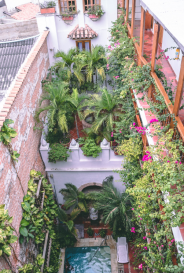
Central open-air courtyards (patios) function as passive thermal regulation systems. As heat rises through the open center, it draws air through shaded ground-floor arcades (portales) and timber-framed balconies, creating continuous internal cross-ventilation. Roof structures feature heavy tropical hardwood framing (carpinterÃa de lo blanco), engineered to support clay tiles and withstand extreme tropical humidity.
Republican Residences (Late Nineteenth-Early Twentieth Century)
Following Colombian independence, European architectural styles influenced affluent urban residential design. Republican properties retained the internal courtyard and passive cooling principles of colonial design, but introduced neoclassical facade styling, higher room volumes, tall French windows, ornate iron balconies, interior plaster moldings, and hand-painted geometric cement floor tiles (baldosas hidráulicas).
From an investment perspective, adaptive reuse the process of modernizing historical structures for contemporary residential or boutique hospitality usepresents technical challenges. Integrating subterranean HVAC cooling systems, modern electrical grids, advanced plumbing, and private swimming pools into centuries-old masonry requires specialized historic preservation engineering.
|
Engineering Vector |
Historical Asset Challenge |
Institutional Mitigation & Value Enhancement |
|
Masonry & Moisture Control |
Rising dampness and salt crystallization in lime mortar |
Lime-grouting injection, breathable micro-porous coatings, and passive perimeter drainage systems |
|
Structural Load Management |
Foundation settlement under added pool or upper-floor loads |
Micropile installation and structural floor diaphragms engineered without altering historic facades |
|
Climate Infrastructure |
Integrating high-capacity HVAC in high-humidity, high-salinity zones |
Concealed chilled-water ducting systems, marine-grade condenser units, and moisture-controlled interior zones |
|
Utility Grid Capacity |
Variable municipal electrical and water pressure limits |
Subterranean water storage cisterns, back-up power generation, and private voltage stabilization systems |
Properties that have undergone comprehensive, heritage-compliant modernization represent prime turnkey assets within Luxury Real Estate Colombia. These rehabilitated casonas command significant valuation premiums because they eliminate complex technical execution risks for subsequent institutional purchasers.
Institutional Perspective A restored colonial casona is not merely a residence; it is a specialized engineering system that has survived centuries of tropical environmental exposure. The capital premium paid for modern heritage properties reflects the cost of overcoming technical adaptive reuse challenges while retaining the asset's non-replicable historical fabric.
Spatial Micro-Markets: Neighborhood Taxonomy and Capital Utility
The market for high-value properties in Cartagena is geographically micro-segmented. Each neighborhood within the historical, modern, and island perimeters offers distinct spatial characteristics, zoning allowances, and capital profiles.
El Centro (The Historic Core)
El Centro is the historical seat of civic, religious, and commercial authority. It contains the city's grandest multi-story casonas, former conventual complexes, and major plazas.
- Spatial Characteristics: High architectural density, narrow paved streets, multi-courtyard properties with floor areas ranging from 600 to over 2,500 square meters.
- Asset Dynamics: Highest average price per square meter in Colombia. Property ownership is tightly held by established families, private foundations, and institutional investors.
- Primary Capital Function: Long-term wealth preservation, trophy asset allocation, and luxury corporate retreats.
San Diego
Situated in the northern quadrant of the walled city, San Diego historically served as a residential enclave for merchants, military personnel, and artisans.
- Spatial Characteristics: A subdued residential atmosphere centered around Plaza de San Diego, featuring a uniform scale of single- and two-story colonial homes alongside restored Republican structures.
- Asset Dynamics: Stable liquidity driven by international second-home buyers seeking personal residential properties within walking distance of prime cultural venues.
- Primary Capital Function: Private residential use, generational lifestyle preservation, and steady capital appreciation.
Getsemaní
Positioned east of the main fortification wall across Centenario Park, Getsemaní was historically the outer residential quarter. Over the past two decades, it has undergone significant urban regeneration.
- Spatial Characteristics: Vibrant street life, historic two-story residential homes, artisan workshops, and commercial-residential hybrid properties.
- Asset Dynamics: High transaction velocity relative to El Centro. Active adaptive reuse development transforming historic parcels into boutique hotels, private clubs, and culinary venues.
- Primary Capital Function: Value-add capital deployment, institutional hospitality expansion, and yield-focused strategies for a Cartagena Investment Property.
Bocagrande and Castillogrande
Extending south from the historic core, this peninsula represents Cartagena's modern high-rise coastal market.
- Bocagrande: A dense commercial and residential strip featuring high-rise luxury apartment towers, international hotel brands, and oceanfront developments. Offers direct ocean views, resort amenities, and turnkey property management.
- Castillogrande: A quiet residential peninsula situated along the inner bay. Characterized by wide avenues, bayfront walking paths, low commercial density, deep-water yacht moorings, and high-end residential towers.
- Primary Capital Function: Turnkey coastal living, income-generating residential leasing, and oceanfront lifestyle utility.
The Coastal Fringe: Barú Peninsula and the Rosario Archipelago
Located southwest of Cartagena's bay, the island perimeter represents the non-urban, coastal luxury market segment.
- Spatial Characteristics: Secluded oceanfront compounds, Luxury Villas Barú, and private island estates accessible via private vessel or helicopter.
- Asset Dynamics: Governed by environmental management protocols and maritime regulations. Property value is tied to sea-wall protection, private dock infrastructure, and self-sustaining utility systems (solar arrays, water desalination, and eco-friendly waste management).
- Primary Capital Function: Private marine retreats, off-grid coastal estates, and ultra-high-net-worth family retreats.
Institutional Perspective Capital allocation in Cartagena requires micro-market precision. While El Centro and San Diego serve as capital preservation shelters, Getsemaní provides value-add growth potential, Castillogrande delivers modern maritime lifestyle utility, and Barú offers secluded coastal privacy. Portfolio performance depends on matching capital objectives to the appropriate micro-market vector.
Market Dynamics: Off-Market Execution, Operational Yields, and Capital Protection
The structural maturity of the Cartagena luxury market has led to complex transactional dynamics that distinguish it from standard real estate markets.
The Dominance of Off-Market Transactions
The most valuable historic casonas in El Centro and primary bayfront estates in Castillogrande rarely appear on public sales portals or open listing platforms. Privacy considerations among high-net-worth families and institutional entities mean that premier assets are transacted primarily through Off Market Properties Cartagena networks. Accessing these opportunities requires direct relationships with a professional Cartagena Real Estate Advisor, discreet market intelligence, and institutional credibility.
Operational Yield Strategies and Flexible Asset Utility
Unlike many European heritage cities that enforce strict bans on short-term leasing or corporate usage, Colombia's legal framework permits flexible property usage, subject to municipal registration and horizontal property rules. Historic assets can be configured as:
- Private Single-Family Estates: Low-density, exclusive residential use preserving architectural integrity.
- Boutique Hospitality Assets: Professional management converting historic casonas into high-yield boutique hotels or private membership clubs.
- Corporate and Executive Retreats: Multi-use properties leased to international corporate clients or family offices for private events and executive stays.
This operational flexibility allows property owners to generate hard-currency income to cover holding costs and maintenance reserves while maintaining ownership of an appreciating asset.
Resilience and Capital Expenditure Management
Maintaining luxury properties in a tropical maritime environment requires structured capital allocation. High-salinity air, intense humidity, and coastal weather require continuous preventive maintenance. High-value property management frameworks allocate specific capital reserves for sacrificial anode systems, desalination infrastructure, and redundant energy systems to protect long-term equity.
|
Micro-Market |
Primary Asset Typology |
Typical Price Range (USD Equivalent) |
Key Capital Risk |
Primary Value Driver |
|
El Centro |
Historic Colonial Casona |
$2.5M - $12.0M+ |
Complex PEMP compliance & restoration execution |
Absolute spatial scarcity & UNESCO protection |
|
San Diego |
Restored Residential Heritage |
$1.2M - $4.5M |
Historical parcel footprint limits |
High residential livability & quiet urban character |
|
Getsemani |
Adaptive Reuse Property |
$800K - $3.5M |
Commercial transition & noise management |
Capital appreciation & high boutique hospitality yield |
|
Castillogrande |
Bayfront High-Rise Condominium |
$600K - $2.2M |
Building HOA governance & tower age |
Deep-water bay access & modern amenities |
|
Baru / Islands |
Oceanfront Villa / Island Compound |
$1.5M - $8.0M |
Maritime logistics & off-grid utility maintenance |
Private coastal seclusion & deep-water access |
Institutional Perspective In a market defined by unique, historic assets, broad information availability is often misleading. Real value is created through rigorous selection—identifying hidden risks, verifying historical compliance, and securing assets that offer genuine long-term capital stability.
Widening Perspective: The Strategic Horizon of Heritage Capital
To evaluate Cartagena's place in the global real estate landscape, one must look beyond short-term market cycles. The long-term trajectory of global real estate is increasingly shaped by two macro-forces: the widespread expansion of monetary supply and the growing rarity of authentic, non-reproducible physical environments.
In an era where modern urban centers can replicate luxury residential towers indefinitely, true luxury shifts from material abundance to spatial and historical uniqueness. Multi-story towers with identical high-end finishes can be constructed in any global city; however, an eleven-kilometer ring of seventeenth-century stone walls enclosing five hundred years of living architectural history cannot be built again.
Cartagena stands at the intersection of these macroeconomic realities. It offers global capital an asset class that is physically protected from developer oversupply, legally insulated by national and international preservation mandates, and positioned within a growing Latin American trade and tourism corridor.
For family offices, institutional investors, and ultra-high-net-worth individuals, acquiring property within this historic coastal gateway is not merely a lifestyle acquisition. It represents the strategic conversion of liquid capital into an enduring real asset-one that preserves equity across generational horizons while providing a unique anchor in one of the Caribbean's most historically significant urban environments.
Key Takeaways
- Absolute Spatial Inelasticity: The historic core of Cartagena represents a closed asset system bounded by sixteenth-century defensive walls and UNESCO protection, preventing inventory expansion and insulating property values from oversupply risks.
- Institutional Regulatory Protection: The legal framework of the Plan Especial de Manejo y Protección (PEMP) protects neighboring property values by prohibiting unauthorized height additions, facade alterations, or disruptive land uses.
- Cross-Border Capital Decoupling: As foreign private wealth ownership expands, prime property valuations in Cartagena increasingly decouple from local economic cycles and align with global private capital trends.
- Architectural Capital Integrity: Restored colonial and Republican properties function as compound real assets, where passive environmental engineering and structural historic fabric represent a substantial portion of the underlying capital value.
- Off-Market Execution Imperative: The most valuable heritage properties trade within private networks, requiring specialized institutional advisory, legal due diligence, and discreet execution to navigate successfully.
Related Institutional Publications
- The Evolution of Luxury Hospitality in Cartagena
- Adaptive Reuse of Colonial Architecture in UNESCO Zones
- The Economics of Off-Market Real Estate in Latin America
- Family Office Capital Allocation in Emerging Market Heritage Assets
- Preservation as an Inflation-Hedged Investment Framework
- Comparative Valuation Dynamics Across Caribbean Coastal Enclaves
About RALVENZ
RALVENZ is an independent Luxury Real Estate Advisory & Representation Firm headquartered in Cartagena, Colombia.
The firm provides institutional-grade analytical rigor, strategic advisory, and private representation for international investors, family offices, and ultra-high-net-worth individuals navigating Colombia's luxury real estate market.
Operating with absolute discretion, RALVENZ specializes in heritage assets, private coastal estates, off-market opportunities, and long-term capital preservation.
Its practice is founded on independent judgment, rigorous due diligence, institutional representation, and the long-term stewardship of exceptional real estate assets.